

Beer is the Mind-Killer — Brewing Spice Beer From Frank Herbert’s “Dune”
“The spice must flow.” — Baron Vladimir Harkonnen
“Spice,” or “spice melange,” is the most important resource in the Dune universe. A mysterious element that exists on a single planet—the desert world of Arrakis—it is a byproduct of the giant sandworms that inhabit it. In Frank Herbert’s first novel in the series, Paul Atreides, the son of Duke Leto Atreides, is uprooted from his home planet as his family are granted custodianship of Arrakis (all part of a complex plot by the Emperor to destroy the Atreides family, as it turns out).



We soon learn that spice is necessary to facilitate safe interstellar travel, making it an analogy for modern-day fossil fuels. Beyond its utilitarian function, spice is also a powerful psychotropic drug (its powdered brown appearance in the novels is an apparent reference to heroin) that is enjoyed recreationally by members of the noble houses.
A substance with the combined value of both oil and opium that exists on only one planet? You can see why the whole galactic empire is fixated on this barren desert world. Of course, it only makes sense that they would also put something as valuable as spice in beer.
Spice beer doesn’t appear many times in Dune. It’s briefly noted that Duncan Idaho, the Swordmaster of House Atriedes, is drunk on the stuff, but there’s not much detail provided. We do get a lot of description of spice melange itself, however: its characteristics, flavour, texture, and scent. Several characters remark that spice melange tastes and smells of cinnamon, so a cinnamon beer would be an obvious route.
However, Dr. Yueh, who served House Atreides, says that spice tastes different every time, suggesting that cinnamon may be a base but that there are other flavours in play. “Spice melange” backs up the idea of a more complex flavour as well: “Melange” comes from the French, and translates to mixture, blend, or medley. Therefore, our starting point should be a beer featuring a mix of spices.

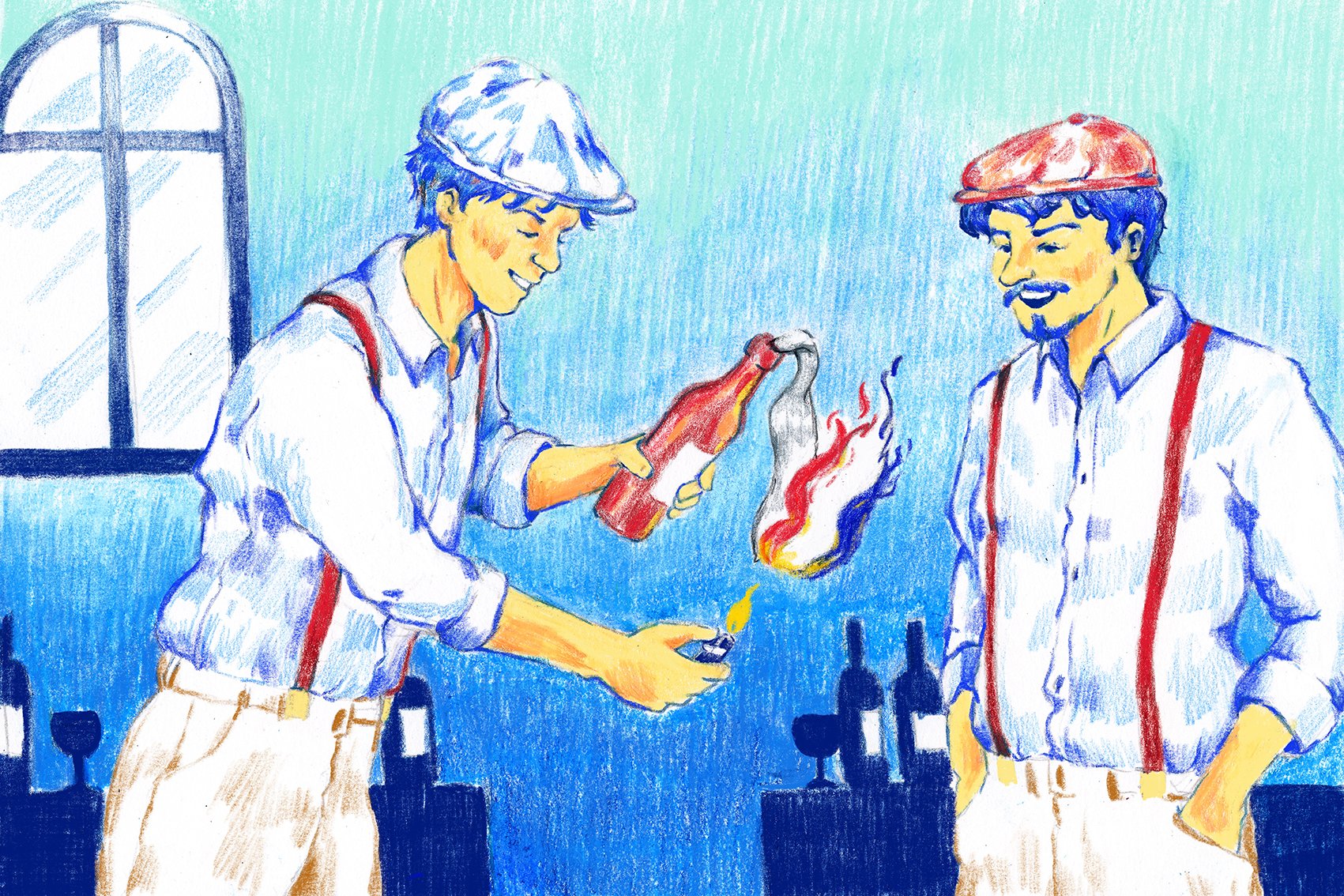
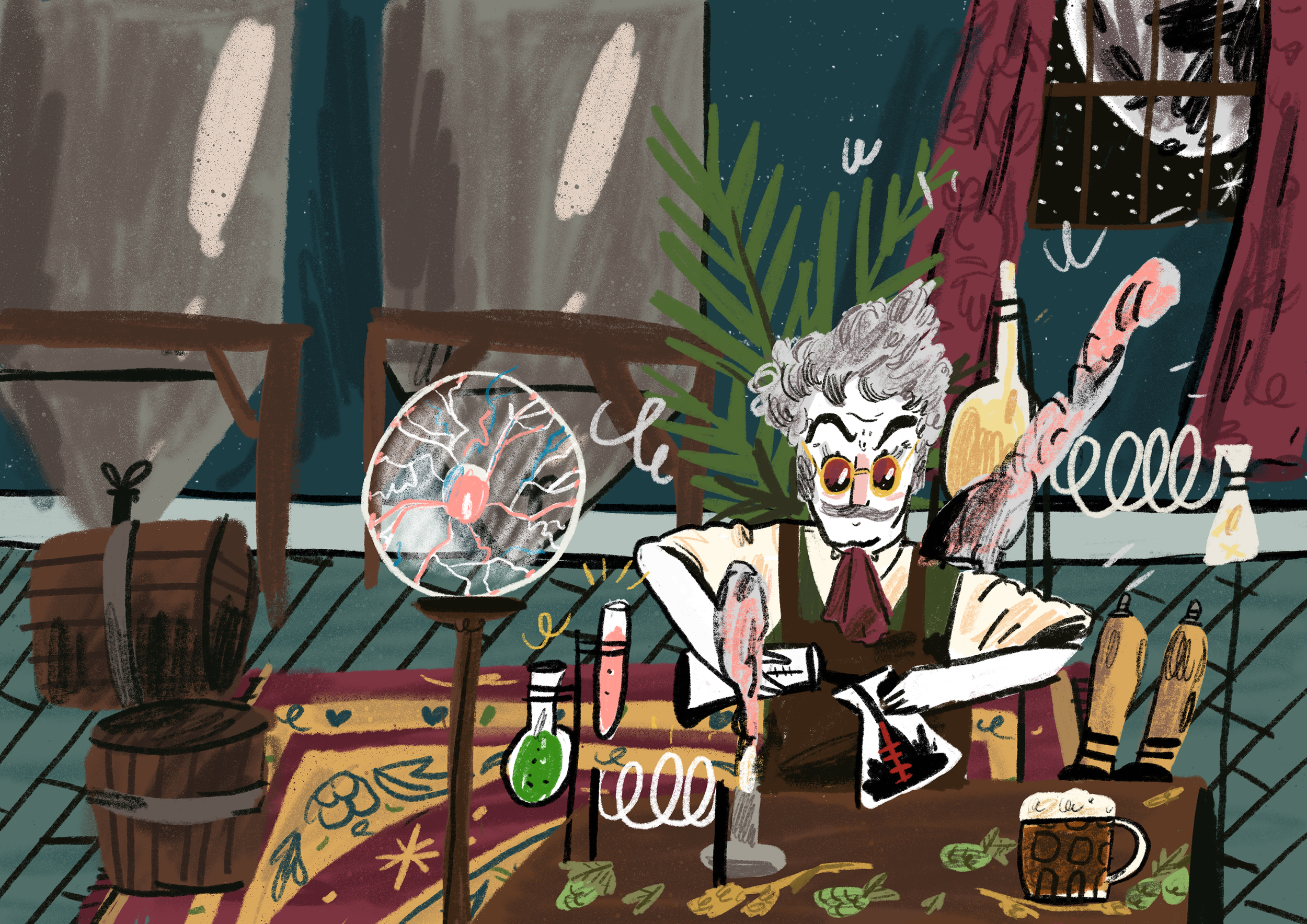
Illustrations by Eilis Dart
Such a beer might call to mind the modern trend of pumpkin spice beers, or more traditional festive ales that feature mulling spices—but in fact, spices have been used in beer for hundreds, likely even thousands, of years. One of the earliest written examples of a spiced ale can be found in A Good Huswife’s Handmaide by Thomas Dawson. Written in 1594, Dawson’s book includes a beer cocktail recipe called “buttered beere” that includes eggs, butter, cinnamon, sugar, cloves, and nutmeg.
Records of other spiced beers go back even further. Professor Patrick E. McGovern, author of Ancient Brews, found evidence of saffron residue in ancient beer pots from the court of King Midas, dating back to around 700 BC. Saffron is the most expensive spice on the planet, so this really was a beer fit for the king with the golden touch. Spices are even present, arguably, in the very oldest beer recipe: The Hymn to Ninkasi. This ancient Sumerian recipe dates back to around 1,800 BC, and features the inclusion of “sweet aromatics,” although some suggest this might have been in reference to the malt’s aroma.
These historic examples inform what our spice beer might be: a beer revered as the work of the gods, a beer for the rich and powerful, a beer for emperors and dukes. Spice melange is the most expensive substance in the galaxy; it follows that spice beer is the most expensive beer. This is not a beer for the masses, not for a quick pint after a hard day’s work in the Harkonnen fighting pits. Such a beer should feature only the best ingredients, the finest malts and rarest hops. A strong, intoxicating, luxurious beer fit for an emperor? It has to be a barley wine—a spiced barley wine.
I started with a base malt of Chevallier: a heritage, landrace British barley variety that largely fell out of use when other varieties with greater yield and disease resistance were developed. This makes it more expensive than other base malts, but it has a richer quality and imparts a distinct marmalade character to beer. Until recently, Chevallier was no longer in production, but thanks to Crisp Maltings—which brought it back in 2017—most homebrew websites now stock it. If you can’t get hold of it, however, Maris Otter can be used as a substitute.
““A strong, intoxicating, luxurious beer fit for an emperor? It has to be a barley wine.””
For speciality malts, I started with my absolute favourite: Briess Extra Special. It adds some of the qualities of roasted malts, with a distinct toffee and raisin flavour, but yields an amber, almost red hue, plus the brown-sugar sweetness of a crystal malt. Melanoidin malt then builds on this base, imparting a honey-like character. Finally, biscuit malt does what it says on the tin: It adds a dry, toasted biscuit flavour that always reminds me of a malted milk biscuit stolen out of my grandma’s orange Tupperware tub. As for the hops, I find Phoenix hops work really well with a heavily malty beer, adding an earthiness but also a dark chocolate character.
In terms of spices, I’ve gone with the nutmeg and cloves from the buttered beere recipe; adding these late in the boil ensures their aromas aren’t lost. I’ve always found cinnamon a little overpowering when used in the boil, but a couple of cinnamon sticks in the fermenter, used like a dry hop, leads to a more subtle, multi-layered character. Mangrove Jack’s Empire Ale Yeast is one of my go-to choices for big beers like this—its own sweet esters blend well with the malt-led character.
Overall, you’re left with a rich, malty, sweet, and thick beer in which the sweet spices present really well. It’s perfect for a cold winter’s night—just like when the temperature plummets after the sun sets on the dunes of Arrakis.
If you decide to give brewing spice beer a go, please let us know. We’d love to hear from you. The spice must flow and the spice beer must pour!



***
Recipe
Target Original Gravity (OG) —1.083
Target Final Gravity (FG) —1.021
Target Alcohol by Volume (ABV) — 8.3%
Target International Bittering Units (IBU) — 28
Batch size — 23L
Ingredients
5.5kg Chevallier malt
1kg flaked oats
300g Briess Extra Special Malt
200g melanoidin malt
200g biscuit malt
20g Phoenix at 60 minutes from end of boil
40g Phoenix at 5 minutes from end of boil
5 whole cloves at 5 minutes from end of boil
1tsp nutmeg at 5 minutes from end of boil
2 cinnamon sticks in fermenter 3 days from start of fermentation
1 x Mangrove Jack’s Empire Ale Yeast

Method
Mash duration — 1 hour
Mash liquor volume — 19.4L
Total grist weight — 7.2kg
Liquor-to-grist ratio — 2.7L/1kg
Mash temperature — 68°C
Sparge liquor volume — 19L
Sparge liquor temperature — 75°C
Boil duration — 1 hour
Fermentation temperature — 18°C