
The Shape of Pils to Come — 30 Years of Birrificio Italiano’s Tipopils
I have a thirst to quench. It’s just as well, then, that I’ve arrived at Birrificio Italiano’s brewery in Limido Comasco, a village 20 miles northwest of Milan.
A keen northerly wind whips across the forecourt, though bright sunlight mitigates its harshness. Once inside, the brewery’s founder, Agostino Arioli—whom I first met in 2008—asks me if I would like a beer. I plump for a Tipopils, the beer that launched the brewery 30 years ago. Having drunk deeply of many glorious examples of the pils style across Europe, from Brasserie de la Senne’s pristine Zenne Pils to Fässla’s crisp and sprightly example, I still believe that this is one of the best on the continent—if not the world.



It’s dark gold in colour, topped with a pristine head of foam. On the nose I pick out suggestions of freshly cut grass on a summer’s day, alongside a hint of lemon balm in the background. It is angelic in the impression it makes on my palate: light malt, the essence of noble hops, more lemon balm, and a dry and bittersweet finish. Despite its translucent delicacy, it is also big and bold in both aromatics and flavour, alongside a crisp and refreshing mouthfeel. My glass is soon empty, and straight away I am handed another bottle.
“Its birth was due to my desire to replicate a flavour that had absolutely enlightened and overwhelmed me at a certain point in my young life,” Agostino tells me. “The first time I drank Jever Pils.”
Agostino says he finds it funny, because Jever—brewed in Germany by Friesisches Brauhaus zu Jever, part of the Radeberger Group—and Tipopils don’t have too much in common. Jever is far more bitter than Tipopils, for starters, and unlike the latter it isn’t dry-hopped.
“That’s just how it goes,” he says. “Beer takes you by the hand and leads you where it wants to go.”
““Beer takes you by the hand and leads you where it wants to go.””
I first investigated Italy’s growing modern beer scene back in 2008, intrigued by what I’d read: Michael Jackson’s final book, Beer (Eyewitness Companions); various travellers’ tales on the internet; and email conversations with an Italian beer-writing colleague, Maurizio Maestrelli. I visited Le Baladin with him, where founder and brewer Teo Musso played music to his fermenting beers and I was spellbound by the immensity of his barley wine, Xyauyù. That trip was also the first time I went to Birrificio Italiano, was introduced to Tipopils, and talked pils with Agostino.
“When craft beer started emerging in Italy, I used to say that Arioli and Musso were like the different coloured eyes of David Bowie,” Maurizio tells me. “Slightly different but both on the same face.”
Looking back at my notes from that first visit, I recorded Agostino saying that Tipopils was “his baby.” As for the beer’s name, “tipo” means “a variety” or “kind of” in Italian, so this was a “kind of” pils. He also said that he drove to Bavaria annually to personally choose his hops. Today, he motors to Tettnang in southern Baden-Württemberg, where he has many friends among the hop growers there.
Agostino was born in Milan, but spent lots of time in the area where he eventually set up his brewery—partly because some of the towns had early beer halls, where he could find beers such as Courage’s Bulldog and Bitter and John Martin’s Pale Ale. He started homebrewing in 1985 as a university student. Eventually, he received a degree in agriculture, with a branch of the course including fermentation and some brewing.
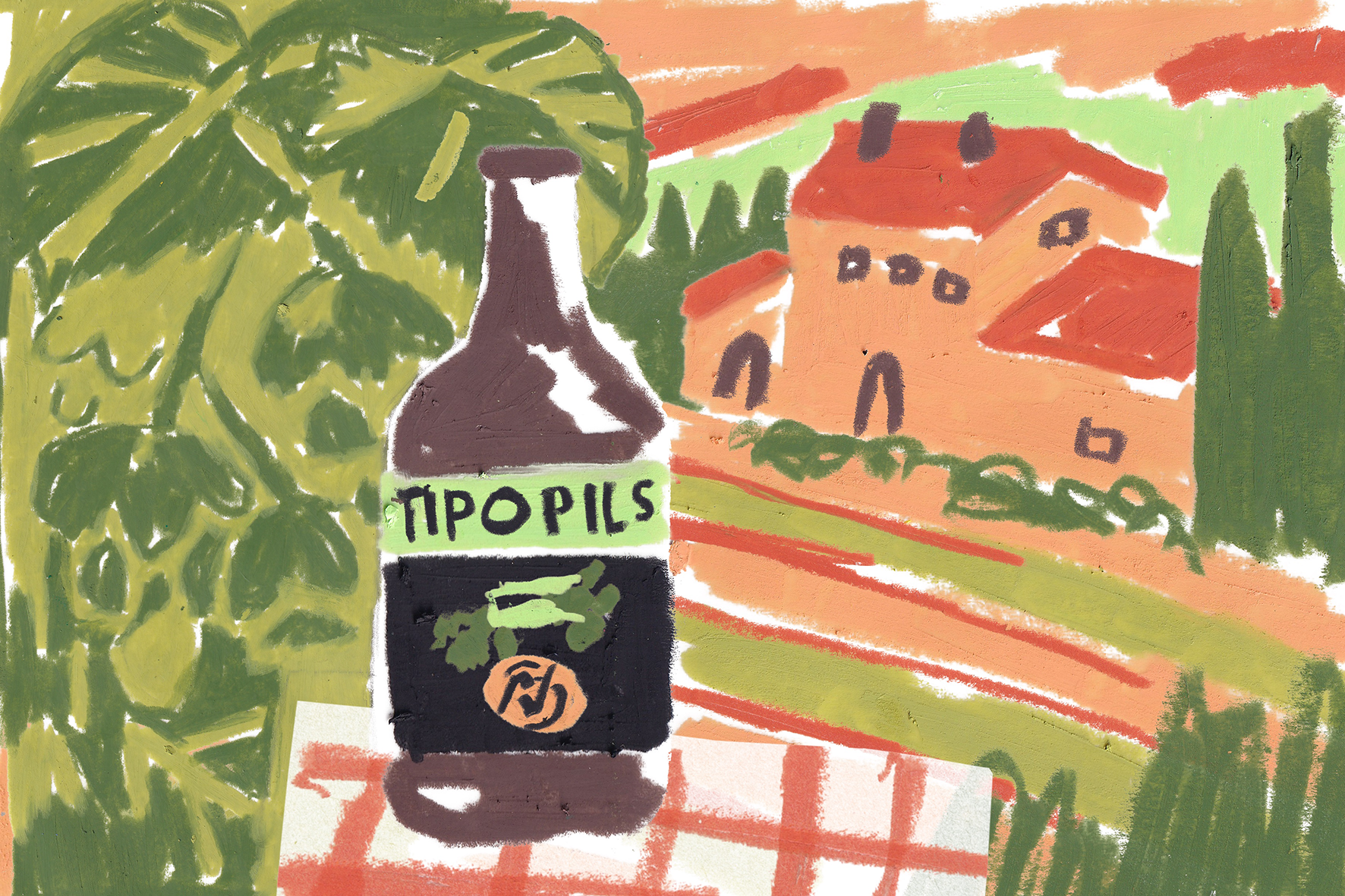
Illustrations by Dionne Kitching
When he opened the brewpub, it was only the third in Italy. In the same year, Teo Musso opened Baladin in the nearby region of Piedmont, to the west of Milan. Things weren’t easy, as there were no suppliers of raw materials for smaller breweries. Agostino’s father’s connections in the brewing industry got him certain supplies, including brewer’s yeast; up until then, he had been using baker’s yeast, which he admits “wasn’t that good.” He also initially faced resistance from locals, with some saying that Tipopils was served too warm. He recalls an elderly local threatening him with a stick, bellowing that Italy was a wine country, before adding “I don’t drink your beer!”
Three decades on, Tipopils is a shining light in European beer, not just in its homeland. Despite this, though, it is probably the best lager that you’ve never had, as it has only occasionally appeared in British bottle shops and the odd bar.
One place that stocked it as far back as 2012 was Leeds’ North Bar. “At the time, I remember it being really unusual,” co-founder Christian Townsley recalls. “I don’t think I’d ever had a pils that had such a citrusy, grassy bitterness. People were describing it as the best pils in the world. Quite a claim!”
If you’ve never been lucky enough to try it, you’ll just have to take my word that Tipopils is one of those beers that on first taste transforms the idea of what you think a pils can be. Matt Brynildson, the brewmaster at California’s Firestone Walker, agrees. He tells me about his introduction to the beer when we meet at Birrificio Italiano’s restaurant in Lurago Marinone (where Agostino initially began brewing in 1996). He’s in town to take part in a collaboration brew alongside Birrifico Italiano, Germany’s Schönram, Denmark’s Bad Seed, Belgium’s Brasserie de la Senne, and Cornwall’s Verdant.
““Agostino was so open about how he made the beer and it really struck me so I went home to California thinking that I needed to figure out how to make this beer.””
“[My] original experience was at European Beer Star,” Matt says. “The fact it won a medal in the kellerpils category that is typically dominated by German brewers really caught my attention. Agostino was so open about how he made the beer and it really struck me, so I went home to California thinking that I needed to figure out how to make this beer.”
Agostino gave Matt enough information—essentially how he was dry-hopping the beer, and using noble hop varieties—so he could attempt a version of his own. In 2013, Firestone Walker launched Pivo Pils. It was an immediate hit, winning gold in the German pils category at the Great American Beer Festival in Denver three years in a row.
“We were always sharing our recipe and I always shared my story about meeting Agostino and gave him credit for the beer,” Matt adds. “But I never thought of it as an Italian pils—it was [just] another great pils.”
Even though not recognised as such at the time, Tipopils is now seen as the first Italian pils, a style currently on the to-make list for many breweries across the U.K. Last year, I had a glass of Duration’s Cuttin’ Grass at Norwich’s compact bar and bottle shop, Beer Hatch, and exclaimed “Tipopils!” Still, when I emailed the brewery’s head brewer and co-founder, Derek Bates, he said he wasn’t sure if he’d ever tasted Tipopils. Still, his explanation of his dry-hopped version of the style correlated with Agostino’s initial inspiration.
“It’s the bones of a German lager,” Agostino says. “Just a bit more about the hop aroma and flavour and not so much the malt, really. I think the key to it and the big difference is the Saphir hops, which give it that pop of lemon and herb.”
Even though Tipopils is considered the first Italian pils, Agostino never intended to invent a new beer style. (That’s usually the case with these things—I’ve never heard of a brewer who leapt out of the bath in the manner of Archimedes and ran naked down the street yelling “Eureka!” because they had invented black IPA.) Agostino says he’s dubious about the idea of beer styles, full stop.
“When I started judging at the World Beer Cup and European Beer Star, the judges were brewers, plus self-taught judges, so most had an idea of balance and pleasantness,” he says. “Nowadays the judges are all about the BJCP [Beer Judge Certification Program], and some of them don’t even know what pleasantness is. All they know is which one sticks better to the standard.”
Agostino says he has not changed his approach to brewing in response to these evolving standards. “We brew what we like; our search is about what we like. I didn’t develop any style, as I don’t like styles, so I feel guilty and ashamed,” he says with a laugh, indicating he’s not being entirely serious. “I [was] not aiming to create any style, but it happened, and of course I am happy about it.”
““It’s a very beautiful beer and the fact that it’s unfiltered allows that dry hopping to shine.””
What makes Tipopils so individual was Arioli’s use of dry-hopping, which was not commonly done to German-style pils three decades ago (or even today). This idea had come from time spent in the U.K., where he had seen publicans dry-hopping beers in their cellars.
His first beer, Amber Shock, was loosely inspired by German bocks, but on opening the brewpub he knew he needed a pale lager. He designed the recipe for Tipopils with the help of Gianni Pasa, a German-trained brewmaster. For the last 12 years, he’s used Spalter Select and Saphir hops; previously, he worked with the likes of Perle, Northern Brewer, and Magnum. Lagering lasts for five weeks, with no filtration or clarifying agents, finings, enzymes, hop extract or antioxidants added.
Eric Toft is the renowned brewmaster at Schönram in southern Bavaria, and a long-time friend of Agostino’s. Along with Yvan de Baets at Brasserie de la Senne, the three have carried out several collaborations over the past decade. Eric is also in attendance in Lurago Marinone, so I take the chance to ask him why he thought Tipopils stood out.
“Rather than try to copy a pils, Agostino created an internationally recognised sub-style of pils,” Eric says. “He has a pretty interesting take—he strives for a low attenuation. If you go to a lower attenuation, you get a better hop expression; he wants the body and the hop expression. The end result is that it’s a very beautiful beer and the fact that it’s unfiltered allows that dry-hopping to shine.”
Perhaps part of what makes Tipopils so celebrated among Agostino’s peers is his dedication, and his perfectionism.



“Maybe once a year I drink a Tipopils somewhere and I say to myself, ‘Wow, this is great.’ But when I am doing technical tasting in the brewery, I am never happy,” he says.
Even if he’s rarely happy, the rest of the world usually is. “It’s funny, I was resisting Tipopils’ fame for a long time,” Agostino reflects. “For example, 10 or 15 years ago, I was in Rome for a festival. We had eight taps at our booth and decided not to bring Tipopils. A man came to our booth and asked, ‘Don’t you have Tipopils?’ I said, ‘No, but I have many other beers,’ and he went away. He only wanted Tipopils, and this made me angry—but at the same time, I had to realise that Tipopils was a strong brand.”