Reap What You Sow — Nevel Wild Ales and the Real Cost of Sustainability for Small Breweries
There’s no sign outside Ketelbroek Food Forest, but it’s not hard to find.
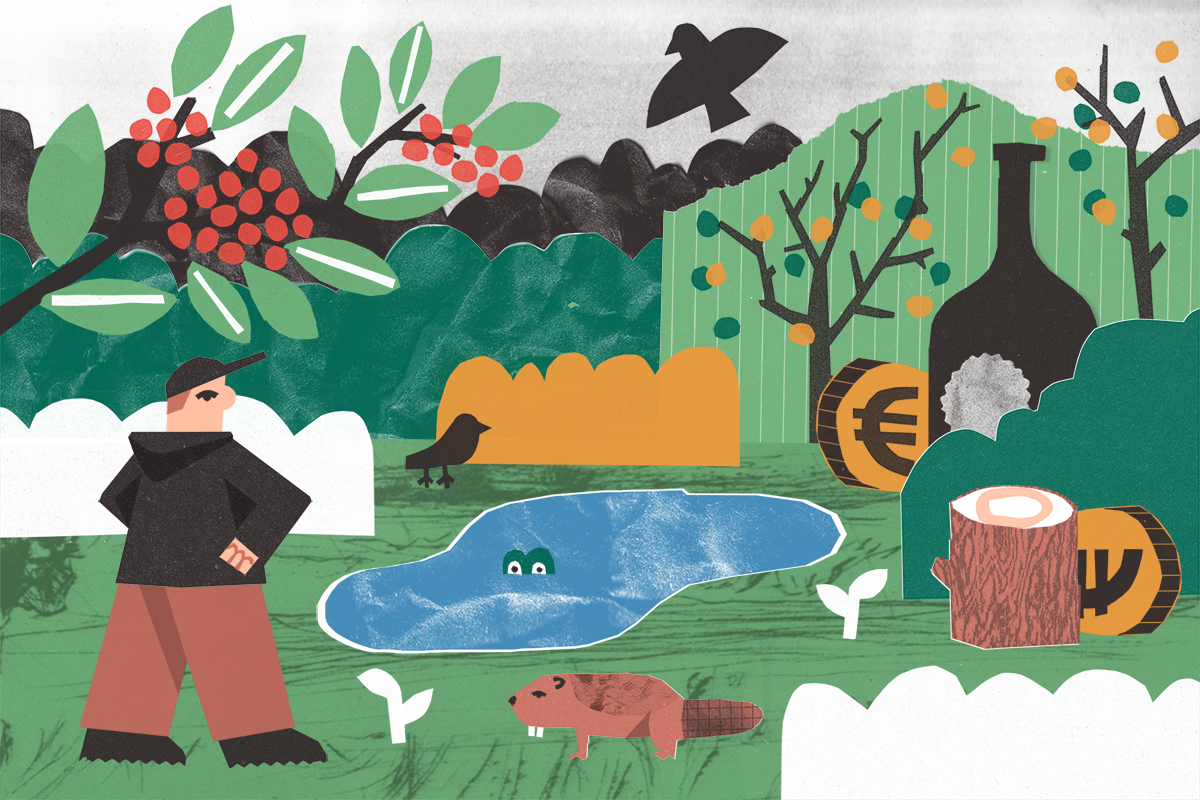
Until it was bought in 2009 by two farmers who were seeking nature-based solutions for growing food, it looked just like the surrounding fields. Now, it’s an eruption of greenery that stands out for miles. Inside its six acres birds sing non-stop, wild boars roam (not during my visit, fortunately), and beavers build dams. Minimal human intervention enables hundreds of edible plants to flourish—even in November there’s Japanese quince to munch, and Sichuan pepper to nibble. I’ve come to this corner of the Netherlands to meet Mattias Terpstra, ex-owner of the now-defunct Nevel Wild Ales.
Mattias founded Nevel with Vincent Gerritsen in 2016, in the nearby city of Nijmegen. They made wild beers with locally sourced, sustainable ingredients, many of which came from this food forest; some were even served in Michelin-starred restaurants across the Netherlands. In 2021, Nevel won Dutch Beer of the Year at the Dutch Beer Challenge. The winning beer, Meander, was a barrel-aged wild blonde beer made with rhubarb and blackcurrant leaf.
“Our goal was to close the gap between nature and beer,” Mattias tells me. “Wild fermentation produces the kind of aromas you find in nature, which fermenting with one strain can’t mimic. By using local ingredients, I grew connections to farmers, their crops, and the natural system behind them.”
However, the values that made Nevel special would also prove to be its undoing. In August 2024, Mattias announced that Nevel would close the following year, as it was impossible to make ends meet.
“We were doing two expensive and time-consuming things at the same time,” he says. “Making a complex product that only a small selection of people actually like, while trying to set up a network of local farmers. A food forest like this is wonderful, but you can’t use it to make beer, as it doesn’t host perennial one-year crops.”
““Our goal was to close the gap between nature and beer.””
It became possible for Nevel to brew beer with 100% local ingredients in 2018, when Dutch maltster Vloermouterij Masterveld opened up 54 miles away in Winterswijk. Until then, Mattias imported organic malt from Steinbach or Weyermann in Germany, but now everything could be sourced (and malted) within Nevel’s home province of Gelderland. To realise this vision, Mattias had to find sustainable farmers to grow the barley and grains he needed.
“It was the first time the farmers would be growing these crops,” Mattias explains. “They had to buy a lot of equipment, and weren’t sure if they would keep doing it, so they wanted us to pay something in advance.”
The initial solution was crowdfunding. “It was partly practical, but I also wanted to teach people about the intricacies of how difficult it is to go back to a system where food is grown locally,” Mattias says. “It’s not the most efficient way of doing it, but I wasn’t trying to make the most sustainable beer in quantifiable parameters. Heineken can do that much better. I want people to notice the difference between a plot that has been sprayed dead with pesticides and one that hasn’t. To join the dots when they pass somewhere food is grown, then eat or drink something. Once you see the difference, you can’t unsee it.”
Social sustainability was equally important for Nevel. The network of local producers Mattias established for sourcing ingredients—from hops and barley to chestnuts and kiwi fruit—showed him the challenges of farming at a small scale. “It isn’t economically viable at all,” he says. “Even if there’s a living wage being paid, the price doesn’t take into account the fact that most people harvesting the crop are volunteers. If they were paid a living wage, the price would be three times more expensive.”
This was one of the reasons Nevel introduced a pricing system in which everyone in its supply chain was paid fairly. It showed where every cent of the price of a beer went, from farmers to owners—and why this meant prices had to go up. The transparency was admirable, but unrewarded. “People that reacted verbally were cool, but in practice most weren’t willing to pay the prices,” Mattias says.
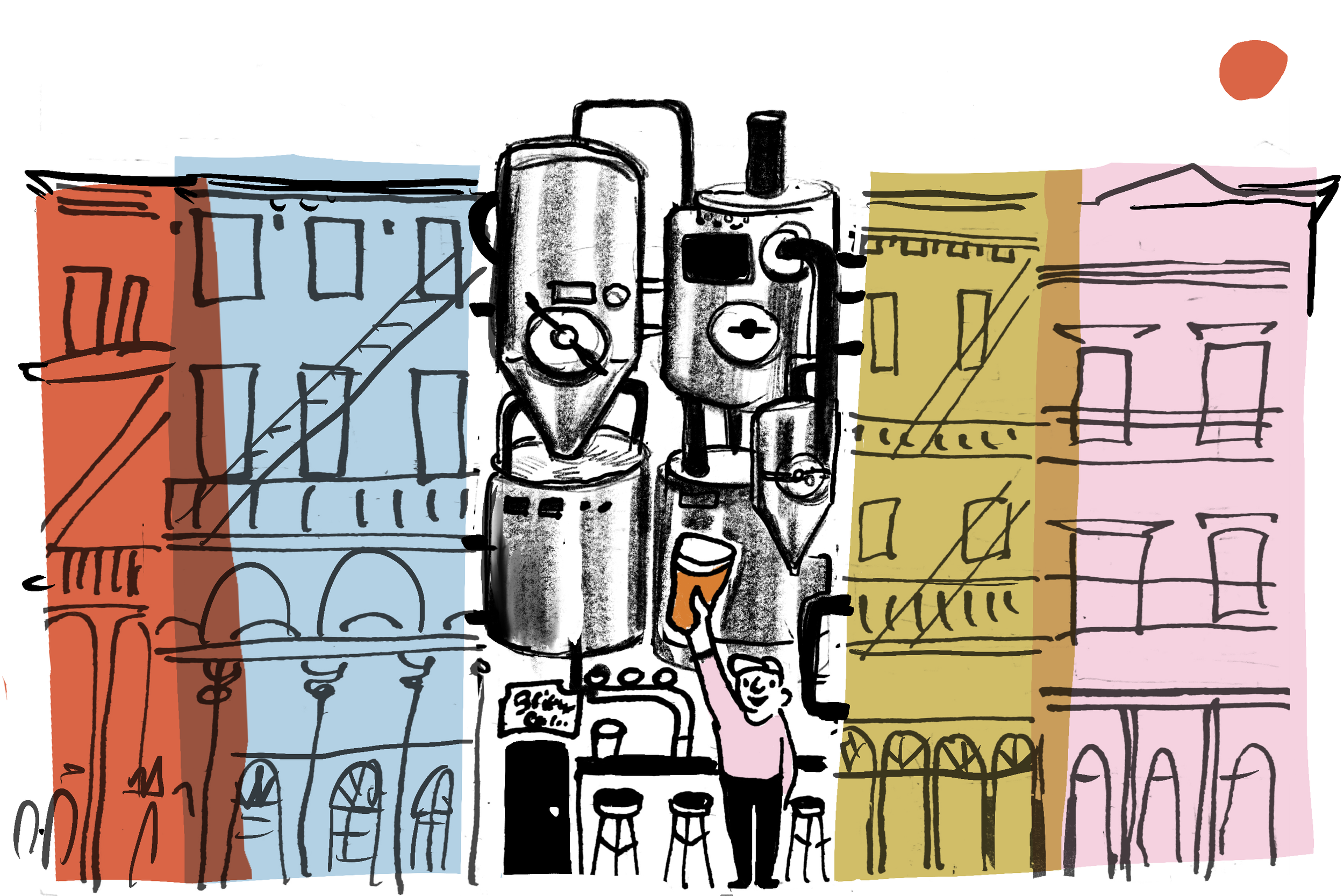
Illustrations by Dionne Kitching
A tactic to increase revenue was getting organic certification for three of Nevel’s flagship beers: Alm (a wild blonde beer), Erve (a wild IPA), and Weide (a wild grisette). “We wanted to upscale these beers by getting into organic supermarkets across the country,” Mattias says. “Their buyers only talk to you once you have the organic label, so certification was essential. But once we saw how much time and money it would take, and how much they would buy our beer for, we saw it was going to cost money instead of making it.”
His experience throws the value of the organic label into question. “Organic doesn’t always mean sustainable,” Mattias says. “This food forest is certified, but I know farmers that work in exactly the same way who aren’t going to certify a piece of land of five acres. It costs too much, and using herbicides or pesticides doesn’t make sense in that context anyway.”
Wouter van Eck, the co-founder of Ketelbroek Food Forest, agrees. “Organic certification is too bureaucratic for small producers,” he tells me. “On the scale at which Nevel and we work, we know every producer and their product. We can cycle to visit each other and see it’s done right. With a basis of trust, certification isn’t necessary. But if you increase production levels and sales markets, I can understand that it is, because there’s a lot of greenwashing, and people who claim to be organic when they’re not.”
One business that does manage to operate sustainably at a larger level is Stroud Brewery in Gloucestershire, England, which has been proudly organic since 2008. Greg Pilley, its owner and founder, is familiar with the challenges such businesses face.
“There’s always a force trying to market something as sustainable,” Greg says. “Take regenerative farming—it simply means improving on where you’re at. If you make an incremental improvement to poor practice, you’re a regenerative farmer and can sell your product quite cheaply compared to the organic standard. That’s why we became an organic brewery, of which there are only five or six in the UK, to have a genuine third-party valuation of what we’re trying to do.”
““At the end of the day, when somebody goes to the pub they just want a great tasting pint. The values we stand for matter less.”
”
Stroud Brewery also has B-Corp certification (in fact, it was the first brewery in the UK to receive it), as well as SALSA Plus Beer, a food and safety accreditation.
None of these certifications are cheap, and Greg explains how even demonstrating to customers that you’re doing the right thing comes at an increased cost. In a sector whose margins are already squeezed, 25–50p extra on a pint of organic beer can be too much.
“As an organic brewery, we have an added value that allows us to justify and command our price,” Greg says. “But at the end of the day, when somebody goes to the pub, they just want a great-tasting pint. The values we stand for matter less.”
Miel Blok of Beer Dudes, a Dutch bottle shop, echoes this opinion. When I ask him how often his customers ask for organic beer, he laughs: “Never.”
“People like the idea of sustainability,” he says. “But in the end they pay for the taste. How Nevel made beer adds to the story, but the combination of doing something good and getting something great in return is why people buy their beers.”
Brewers like Mattias and Greg seem to have the odds stacked against them. “The fact of the matter is that sustainability is completely voluntary,” Greg says. “There’s no obligation for a business in the UK to do anything towards a sustainable sort of goal. As long as that’s the case, there’ll always be competition that is cheaper than doing the right thing for people and the planet.”
But Greg doesn’t doubt what he’s doing. Whether it’s in his role on the sustainability panel of the UK’s Society for Independent Brewers (SIBA), or when giving advice to anyone interested in going organic, he pushes the industry to think bigger than merely reducing emissions. Banking responsibly, embracing the local economy instead of relying on (inter)national sales channels, and fossil-fuel-free pension schemes are all ways small breweries can have a large impact. Yet all too often making, or sticking to, these changes comes down to a choice between saving your business or the environment. Greg’s the first to admit it’s not the easiest path, and even though he feels that Stroud Brewery always seems to grow, it’s a struggle.
Similar financial concerns led Mattias to stop brewing. “It really wasn’t financially viable,” he tells me. “After eight years of trying to manoeuvre Nevel into something that could make money, but always just didn’t, and setback after setback, my energy was just gone. It was a very emotional process. I believe it’s my calling to make stuff that tells the story about where we’re sitting, so it felt like failing.
“Luckily quite soon, with the help of talking to other people about it, I realised that Nevel as a company didn’t work, but the ideas behind it are still strong in me,” he continues. “So I don’t think Nevel failed. I hope I planted a lot of seeds in people’s minds about how things can be made differently.”
““People like the idea of sustainability... but in the end they pay for the taste.””
Some of those seeds bore fruit when Miel bought half of the last beers produced under the Nevel banner. “I heard Mattias was stopping and I wanted to help,” he says. “In a way it was a risk, but I think it will be fairly easy to sell. There are still very loyal fans and people still want to drink the beer.”
More than that, Miel wants to keep Nevel alive for as long as possible. “Nevel taught me a lot about beers I didn’t know before,” he explains. “I feel it’s my mission to pass on what I learned, and make beers available that otherwise wouldn’t be.”
Maybe that’s why I’ll most miss Nevel. I was sad when it closed; a brewery like it deserves to thrive. Nobody else in the Netherlands, or nearby, makes wild beers of similar quality with the same ideals. The question is whether anyone else wants, or can afford, to do so.



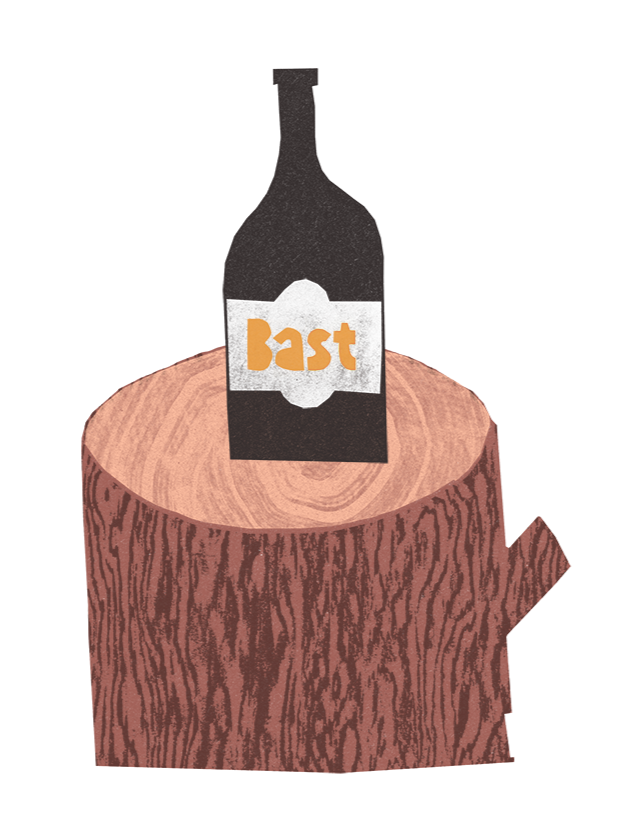
Back in Ketelbroek Food Forest, Mattias brings out a bottle of Bast. It’s a dark ale he aged in oak barrels for 23 months with pine and spruce needles, birch bark, blackthorn branches and blossom, and roasted willow bark. The pine, spruce, and willow came from this forest, and one of the branches Mattias stripped for bark is lying just behind us. I’d be lying if I said I could pick out each kind of wood in the taste, but everything is in balance. It’s rich and sour, fruity and earthy. I’ve probably never had a beer so closely rooted in the place it comes from.
As we sip it in the late autumn sun, surrounded by flourishing nature, and eat bread Mattias made with grains from local, sustainable farmers, all feels right with the world. Nevel might have stopped, but Ketelbroek, and the world around us, goes on.