
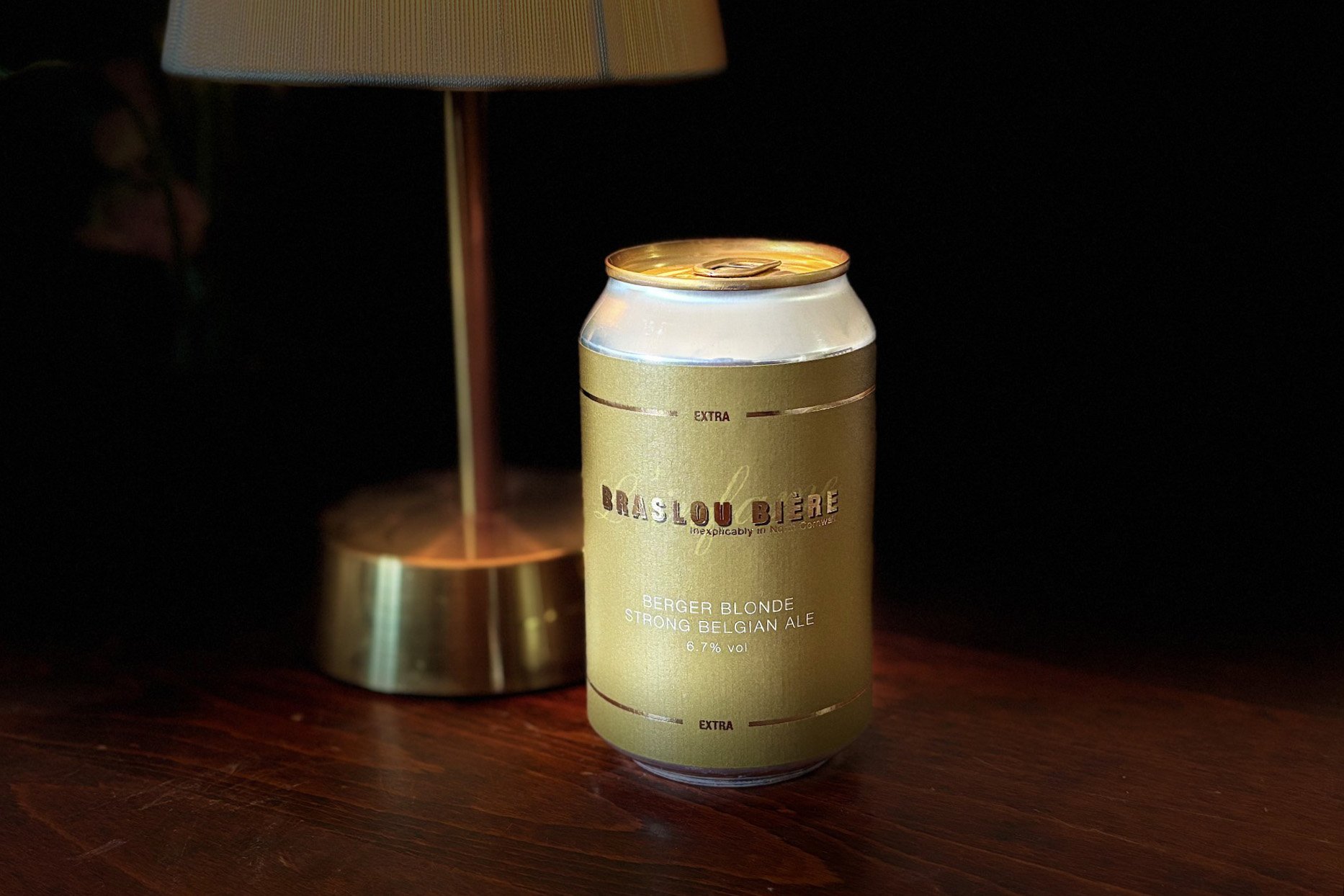
There’s Something Brewing in Cornwall
This week we’re pleased to present an excerpt from the hugely enjoyable “Something Brewing in Cornwall”, the new book from writer and brewer Tommy Barnes. This is the third instalment in his Braslou Bière series, in which Tommy recounts how he moved his brewery of the same name from Braslou, in central France, to just outside the Cornish town of Wadebridge. Published by Muswell Press, the book is available to buy now.

***
“This is Tommy, he had his own brewery in France,” said Lee, the deputy head of brewing at St Austell.
A gang of seven or eight hard Cornish brewers lying around the processing room on the piles of hops and malt, black St Austell outfits faded by years of hard graft, stained by acid and caustic, stared at me with a sort of amused disapproval.
“Hi guys!” I chimed, like an absolute cockhead.
The gang of hard Cornish brewers didn’t respond, save for one muttering under his breath, “fucking hell.”



I’d been referring to groups of people as ‘guys’ for a couple of years now and it pissed me off. It’s a terrible term of address. But I don’t know, as I got older I had been backed into a corner. You can’t be calling people ‘dudes’ when you’re in your forties. And I couldn’t say ‘lads’. If I said ‘lads’ people would laugh at me because I’m not in that lads zone. Same as if I said ‘boys’. I couldn’t carry it off. So, what else can you say? ‘Gents’? What does it say about you if you’re calling people ‘gents’ though? I think you need to be tall and in command to be calling people ‘gents’. If I said that it would feel grasping and artificial, and people would think I thought a lot of myself. ‘Mateys’? Cock.
So, I was left with calling people ‘guys’ and it didn’t suit me and I didn’t suit it. I sounded like a simpleton.
“Tommy is the new brewery apprentice. He’ll be splitting his time between the brewery and the packaging departments—racking casks, kegging and bottling. He’s going to start in packaging to get a feel for the brewery and then he’ll come up to the brewhouse with you, Tom.”
Tom, as previously mentioned—a massive man with a great ginger beard and a friendly face, maybe the only friendly face in the room—nodded at me. The others grumbled and got back to talking to each other about an issue with one of the conditioning tanks. Lee shuffled me out fairly quickly. On to the bottle hall.
“OK Tommy, we’ll start you off here today and see how you get on,” said Lee. “Hi guys!”
““Any myths about frolicking amongst the malt sacks and sipping Big Job atop a gleaming fermenter in the sun were dispelled by my first day in bottling.””
I don’t know what I was really expecting from the brewery when I applied for the job back in France. The truth is if you’re like me and all you’ve done is a few cushy office jobs you have no idea what this sort of work is, and you would be shocked. Any myths about frolicking amongst the malt sacks and sipping Big Job atop a gleaming fermenter in the sun were dispelled by my first day in bottling. I mean, hell, touché to those guys who can stick it out in the bottling hall. You wear ear plugs because from the moment you push through the clear plastic curtains there is a relentless, maddening jangling of bottles tapping against each other as they make their way round the vast conveyor belt that snakes half of the entire hall. It begins with empty, unlabelled bottles and ends with the finished article safely tucked into boxes of twelve via filling, capping labelling and boxing machines.
My job for the day was to unload the boxes as they made their way off the conveyor belt at the end of their journey. That was it. As the box came down you took it off the conveyor belt and placed it on a pallet. There was a certain pattern you had to put the boxes on the pallet to make sure they fitted, but that was the only complexity in the job.
Don’t get me wrong, even that level of sophistication proved my match and it took me much longer than wasn’t embarrassing to get the hang of it. But the rest of the job was crushingly boring. Just standing there lifting boxes as the endless line of bottles clinked along the conveyor belt. There’s a huge clock on the wall, but I soon realised this was just to torment us. Honestly, it would seem like you’d been stacking boxes for hours and hours, you’d look up at the clock and it wouldn’t have fucking moved. I don’t know what Einstein would have made of it but I am telling you now, time stopped in that bottle hall. That day of bottling went on forever. I think it’s still going on.

Day 2. Kegging—filling kegs pressurised with CO2 , and sometimes nitrogen, with beer. These are the fizzy beers you get on draft at pubs. Kegging wasn’t so bad. Similar idea really, but you’re not in the bottling hall so that’s one thing and you load the kegs manually at the start of the machine, then they get whizzed around on the conveyor belt and come back to you filled.
But what elevates it from the bottling hall is you get to use this extraordinary keg moving machine, a giant sucker on a hydraulic arm that you place on top of the filled keg and then lift up using the handles on the side of the sucker. Then you can carry the kegs weightlessly over to the pallet and press the ‘unsuck’ button to stack them. It wasn’t brilliant but there was a bit more to it than the bottling hall. And it was comparatively quiet.
Day 3. Racking—filling the casks with real ale. At breweries like St Austell, until recently, most beer packaged was for cask. This is the traditional way of packaging beer for hand pumps in UK pubs. It used to be wooden casks, but nowadays nearly everyone uses stainless steel. They’re filled to the brim with ale and sometimes a little sugar is added so they re-ferment in the cask a little.
At St Austell they have a separate unit dedicated to cask racking, or filling casks, up at the top of the carpark. “Hi guys!” I chimed. A gang of pallid, angry looking men ignored me. The guy in charge took me under his wing. “OK, you’ll need ear plugs. Your job is to hit the keystones into the casks.” He handed me a well-worn mallet. “You’ll need this.” At least it won’t be as bad as the bottling hall, I comforted myself.
As we left the crib room an ominous drone filled the air. We entered a dark hall maybe a thousand feet long and although the drone and the despairing looks on the faces of the workforce had given me some degree of trepidation, it still came as a surprise to find that the racking plant is actually the seventh circle of hell. The place was rammed with hellish, post-apocalyptic looking machinery. Great jets of flames shot up from the floor. I might have imagined the flames. The noise was deafening.
““Fucking hell though. That racking plant. It made the bottling hall look like a health spa.””
Forget the jangling of bottles, the thunderous clanging of stainless-steel casks as they made their way round the plant on conveyor belts, through the cask washer and onwards, was enough to shake you to your core. It was dark. Hot. Claustrophobic. You were surrounded by machinery that could take your arm off in a moment.
At various points around the unit poor suffering sinners were dotted doing brutal, menial, unending tasks. I was escorted up onto a gantry where a guy with a similar mallet to mine was standing with it raised above his head in front of a large conveyor belt. A metal cask came round on the conveyor. He put a plastic bung in the side of it (a keystone if you’re a CAMRA guy) and smashed it into a bunghole in the steel cask with one violent blow. He raised his mallet again with metronomic timing as another cask rolled round and CRASH! Another bung was sunk.
The supervisor tapped him on the shoulder and gestured to the cask wacker. He sloped off to another unforgiving task and I replaced him in front of the conveyor belt, mallet above my head. There was little instruction. There was little needed. A cask came round. I steeled myself, placed the bung in and THWACK! A direct hit, but the bung was only partially in. It took me another two thwacks. The guy before me was clearly some kind of virtuoso bung whacker. I had no time to contemplate his talent, because before I knew it another cask was in front of me. CA-SMASH! Not bad, but still not a hole in one. And that was me for the rest of the day.
There in Hades, mallet raised above my head, smashing keystones into a never ending supply of casks as occasionally vicious demon guards flew from the rafters and poked me with fiery tridents. I might have imagined that. Fucking hell though. That racking plant. It made the bottling hall look like a health spa. I left in a state of shock—hands covered in blisters, that din of the casks still ringing in my ears for hours after I returned to the sanctuary of Granny P’s cottage in Padstow.



“How was work?” said Rose. “I wish I was back in France,” I wanted to say. Instead, I said, “Oh yeah, getting a feel for it,” or some bullshit like that.
I could feel something foreboding pulling at my shoulders. Alarm, maybe, but I refused to confront it because, I knew that if I really investigated my emotions I would realise I had made a terrible mistake. It had become apparent that brewing in the Victorian brewery at St Austell wasn’t quite the same as brewing in a barn in Braslou.
Mercifully, after a few days Rob Orton, the head brewer, decided to change me from brewery apprentice to junior brewer, just because I think it weirded people out that the brewery apprentice was a forty-four-year-old man. I claimed it as a promotion. At this rate I would be running the brewery within a month, I said to other brewers with a laugh. They didn’t laugh back. What it did mean was I would just stick to brewing the beer, so no more days in the bottling hall and the wracking plant, at least for now. Brewing at St Austell was hard work, harder work than I had ever done, but compared to the other jobs—the bottling hall or the wracking plant—it was a luxurious life.