A Heart That Never Hardens — Brewing Victorian Imperial Dark Mild
Fancy trying out this week’s homebrew recipe for yourself? Good news: We’ve teamed up with our gracious sponsor, Get ‘Er Brewed, who’ve put together a kit based on Paul’s recipe. Click here to purchase it. Happy brewing!
***
Mild: a dark, lightly hopped, smooth-bodied British ale. The ultimate session beer. Or is it?
Sitting somewhere between 3 to 4% ABV, mild was a popular style from the late 18th to the mid-20th centuries. While it’s not completely dead these days—some older breweries, including Batham’s and Harvey’s, maintain their brands—its heyday has certainly passed. Thankfully, several modern, independent breweries have also shown interest in reviving the style in recent years.



Along with more “traditional” mild, breweries have also released “Victorian,” or imperial, milds at much higher strengths. These can range from 5–6% ABV all the way up to 9%, or even into the double digits. These stronger milds are often described as historical, based on the idea that mild used to be brewed to a higher strength in the 19th century, and has slowly withered into the ultra-sessionable style we see today. Is this actually true? Well … yes and no.
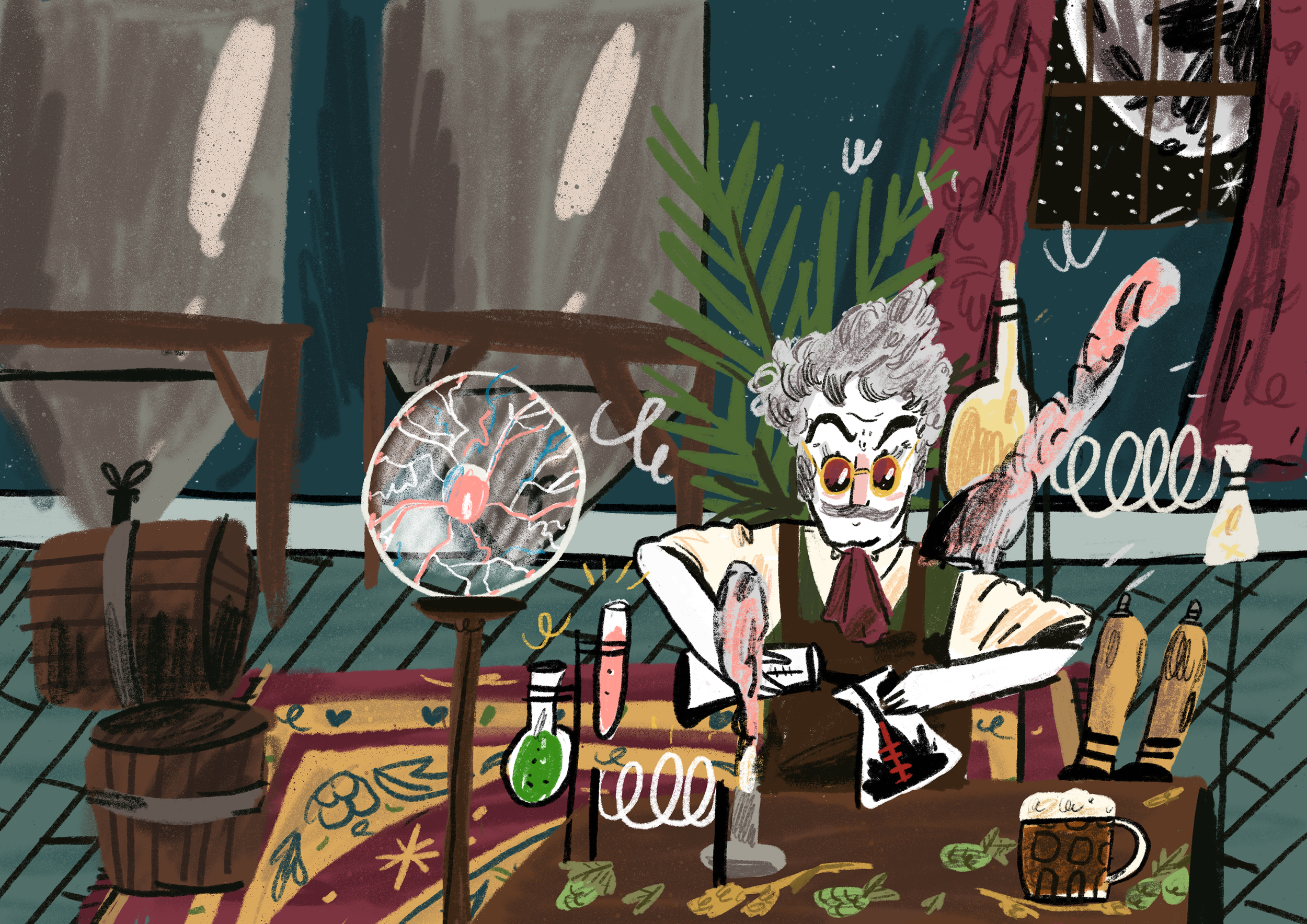
Illustrations by Dick Vincent
For the majority of their history, beer styles existed in a much looser state than the current classified and codified standard produced by the likes of the Beer Judge Certification Program (BJCP). In previous eras, styles were most often just informal terms used by drinkers to indicate the kind of beer they wanted. Bitter, golden, stout, blonde, wit, brown, and weiss were a means of describing that beer to a barkeep—not a series of parameters that a beer had to adhere to.
It was only in the 20th century that beer styles as we understand them today began to take more formal shape—and only in the last 50 or so years that we decided these styles needed strict definition. This development has allowed drinkers to go from pub to pub, city to city, region to region, and country to country, and know what they’re ordering wherever they go. Today, drinkers are not simply asking for a beer that is mild—they are ordering a mild.
If you look through old brewing records, you will see that beers described as “mild” indeed had strengths comparable to these new renditions of Victorian milds. But mild in the 1800s was different in other ways than just its strength. As chronicled by beer historian Ron Pattinson in A Short History of Mild, the term was first used in the 18th century as a simple descriptor for a young, unaged ale, with no other real stylistic differences to other ales. Over time, mild became weaker due a series of economic, agronomic, and legal factors. It also became a darker ale, but only really transformed into its current form around the 1940s.
Mild isn’t unique in this evolution. Other beer styles went through similar—or sometimes more dramatic—transformations. Over the last 150 years, average beer strengths have steadily decreased. Bitter is now codified as a coppery-brown, light-boded, bitter ale; brown ale, once coloured by caramels, is now standardised as sweet and thicker-bodied; stout simply meant strong, but now describes a dark brown or black beer with roasted flavours.
““It’s only in the 20th century that beer styles as we understand them today began to take shape.””
The reality is that mild was not only stronger in Victorian times, but wasn’t actually the same beer it is today. If you were to jump into a DeLorean, travel back to 1885, wander into a pub in the East End of London, and order a mild, it wouldn’t be anything like these modern recreations. You’d be given a beer that was pale, not dark ruby or brown, and which would be hoppier and fuller-bodied, more akin to a barleywine.
Ultimately, we have to ask: Does it matter if these beers aren’t really historical? Not at all! The opposite, in fact. When today’s breweries look to the past and attempt to recreate a historical style, they are really bringing a brand-new style into existence.
Today, a Victorian-style mild should be lightly hopped, with low bitterness and low hop aroma. The fermentable ingredients should include a large quantity of invert sugar. I’ve used Belgian candi sugar, but Lyle’s Golden Syrup, or even honey, will do the job as well. This will convert almost entirely to alcohol, giving the beer a much lighter body compared to a 100% malt beer. Victorian mild should be dark and malty, but not have the roasted character of a stout; I’ve exclusively used chocolate malt, and eschewed the use of black malt or roasted barley, as they might impart a more astringent character. Most importantly, Victorian mild should not be aged. It should be drunk while it’s fresh and lacks any of the sherry, wood, or dried fruit notes that develop in an aged imperial stout.
The finished product does have some additional malt sweetness, and at 9%, has some higher alcohol notes that impart bourbon and liquorice flavours. Still, it remains easy-drinking, and incredibly light-bodied for its ABV.
If you really want to dip into historical brewing, the records are there: You can do a deep dive and make something that more truly represents a centuries-old ale. If, however, you just want to have a bit of fun and do something new with beer, then give this Victorian mild a try.
***
Recipe
Target Original Gravity (OG) — 1.081
Target Final Gravity (FG) — 1.013
Target Alcohol by Volume (ABV) — 9.0%
Target International Bittering Units (IBU) — 24
Batch size — 23L
Ingredients
5kg Maris Otter
500g chocolate malt
50g Fuggles at start of boil
25g Fuggles at five minutes from end of boil
1kg Belgian candi sugar at five minutes from end of boil
1 x Fermentis SafAle S-04 11.5g



Method
Mash duration — 1 hour
Mash liquor volume — 14.3L
Total grist weight — 5.5kg
Liquor-to-grist ratio — 2.6:1
Mash temperature — 65°C
Sparge liquor volume — 19L
Sparge liquor temperature — 75°C
Boil duration — 1 hour
Fermentation temp — 18°C