
We’re Going To Be Friends — Café Beermoth in Manchester, England
It’s a late September evening in downtown Portland, Maine. The streets are eerily quiet as I stumble around in the dusk, trying to find the entrance to a bar called Novare Res.
Novare has been serving the people of Portland since 2008, and has long been on my bucket list of beer destinations. Yes, I love a proper, traditional pub with all the usual fixtures and fittings—but there’s something about a beer bar that I find irresistible. The best have tap lists so exciting they make my heart pound faster. They attract like-minded souls who are as interested in good beer as I am. I’ve ticked off many during my travels: Toronado in San Francisco, La Capsule in Lille, and Goldings Free Dive in Wellington, New Zealand, to name just a few.



When I finally locate Novare’s entrance, I stride in ready and willing to indulge in the delights it has pouring from tap and bottle. There are locally made beers from smaller producers, rare Belgian imports—even a solitary cask handpull. It immediately becomes clear that I’ll be here for a good time and a long time.
Three hours later, as the bar slowly empties and service comes to a close, I’m struck by a thought. Novare, while special in its own right, actually reminds me of another, remarkably similar place. One I frequent much more regularly, and which I don’t have to travel halfway around the world to visit: Manchester’s Café Beermoth.
What a strange feeling, to pine for a bar in my own backyard while on the opposite side of the Atlantic, thousands of miles away from home. But when I think about it more carefully, it makes complete sense. Just like Novare, and those other outstanding beer bars dotted around the world, Café Beermoth treats great beer with the reverence it deserves, but offers it in a way that is inviting and accessible.
Beermoth, however, has one thing going for it above all others: It just so happens to be my local.
***
Today, Café Beermoth is known and loved as a venue that sources exciting beers from independent breweries. But before Beermoth became a café, it was a shop.
In February 2013—when its original location opened its doors at 70 Tib Street in Manchester’s Northern Quarter—Beermoth was, remarkably, the city centre’s first specialist, off-premise beer retailer. It arrived at the beginning of what would become an exciting period of development for the Manchester beer scene. Fellow early adopter Port Street Beer House had opened in 2011, while Blackjack Brewery appeared beneath a railway arch near Angel Meadows, a mile north of the city centre, just a year later.
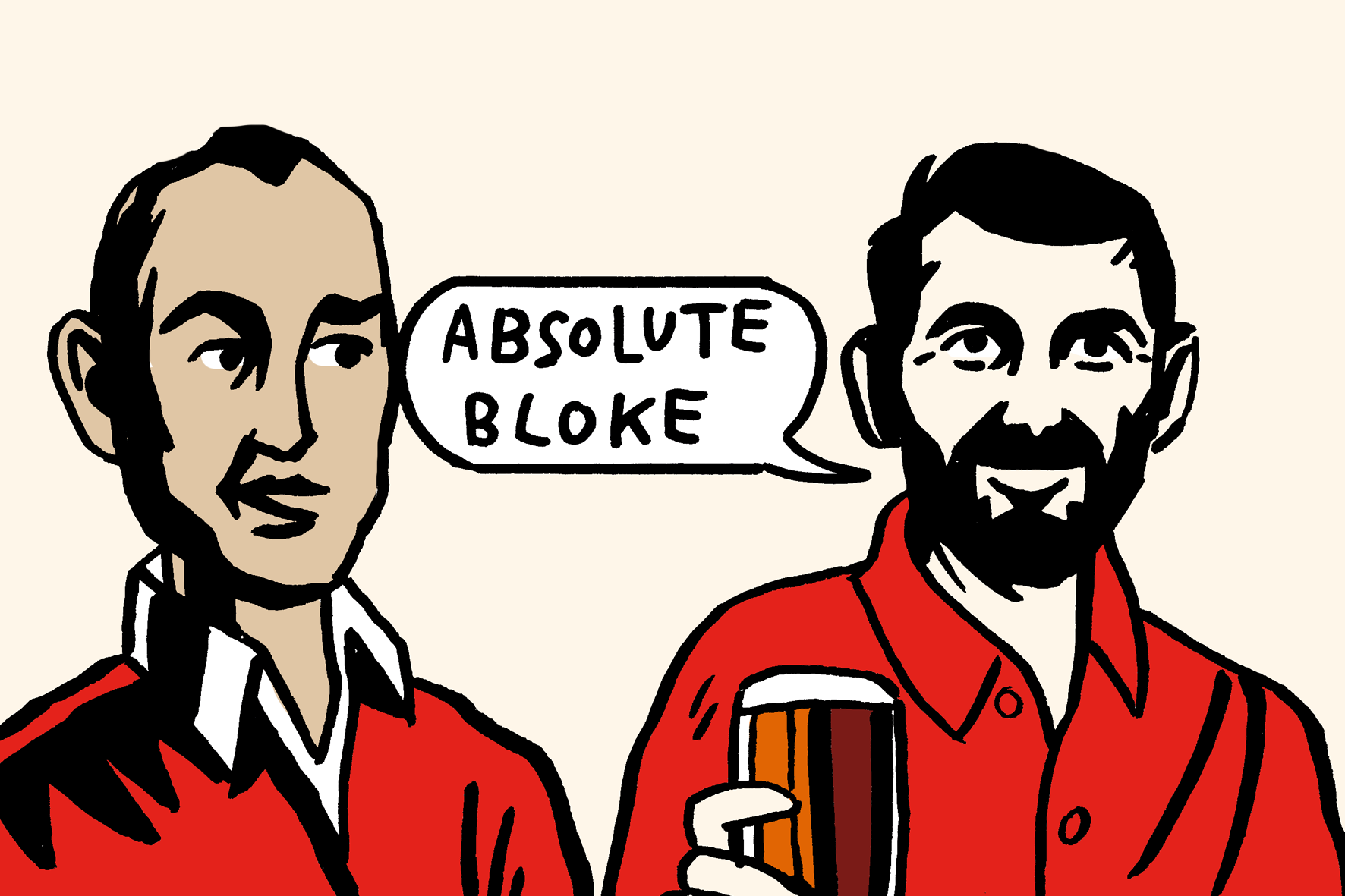
““We really wanted to focus on independent breweries, not just from Manchester, but from all over the world. Like a record shop, but for beer.””
The arrival of Beermoth, established by friends and business partners Scott Davies, Simon Longsdale, and Jeremy Stull, predated many of the names that would later cement Manchester’s status as the best beer city in the country. Before breweries like Track, before Cloudwater, before Runaway, Sureshot, Balance, and Pomona Island, there was Beermoth.
“At some point [Jeremy] asked me if I thought a shop could work, and I was like, ‘Yeah, let’s just do it,’” Scott tells me. “There were other places that sold good beer, but we really wanted to focus on independent breweries, not just from Manchester, but from all over the world. Like a record shop, but for beer.”
Scott had cut his teeth managing Knott Bar, a now-closed beer destination on Manchester’s Deansgate. Meanwhile, Jeremy—who hails from Kansas City, Missouri—was working in Port Street Beer House, and had also spent some time living in the Netherlands. That perspective gave him the chance to experience beer culture’s evolution in Europe, the U.S., and the U.K. Simon was the third piece of the puzzle, supplementing Scott and Jeremy’s enthusiasm with financial nous.
Their diverse experience was reflected in the always-packed shelves and fridges inside the original Beermoth. The long, narrow room—lined with exposed brick from the top of its high ceiling down to its worn wooden floor—quickly became a go-to destination for those looking to take home a bottle or two of something special. Whether it was a rare import or something from one of the new arrivals on the scene, to whom Beermoth offered vital shelf space, there was always something interesting to try.
“Having our beer stocked there was a badge of honour,” says Mark Welsby, who in 2014 founded Runaway Brewery in central Manchester, now based in the nearby town of Stockport. “It certainly helped open doors locally, and gave us the confidence to keep going at a time when that confidence often felt in short supply.”
***
While the shop was cherished by those in the know, Beermoth’s best-kept secret was not the quantity or variety of the beer it kept, but what lay at the bottom of a narrow staircase to the store’s rear.
Down in its dimly lit, cramped basement, where a smattering of excess stock lined the shelves, a proto-Café Beermoth began to take shape. About 20 people could squeeze around the large central table, often to share special bottles such as imported lambic from the likes of Belgium’s Cantillon and 3 Fonteinen, or beer from revered American breweries such as Logsdon Farmhouse Ales, The Bruery, and Crooked Stave.
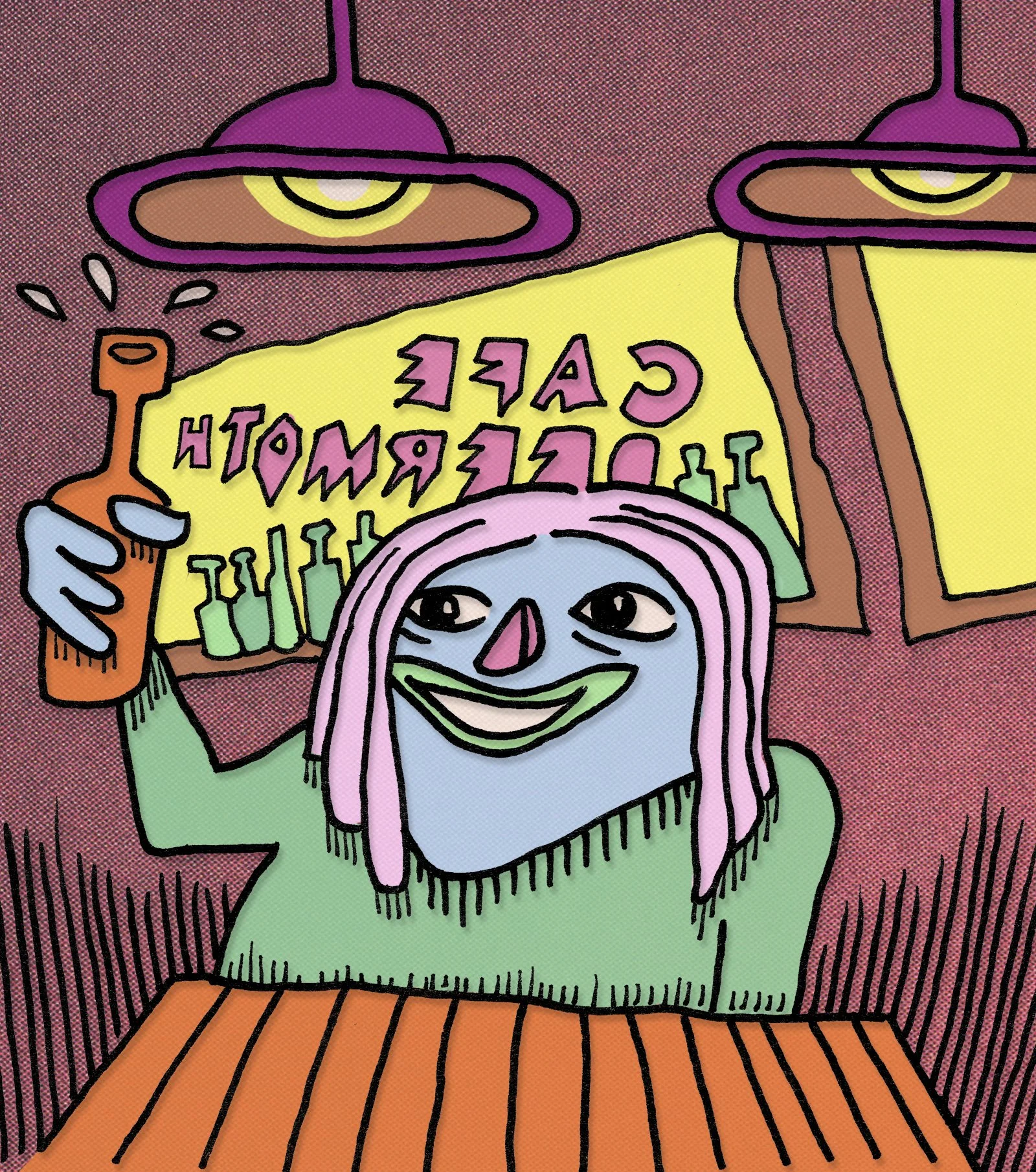
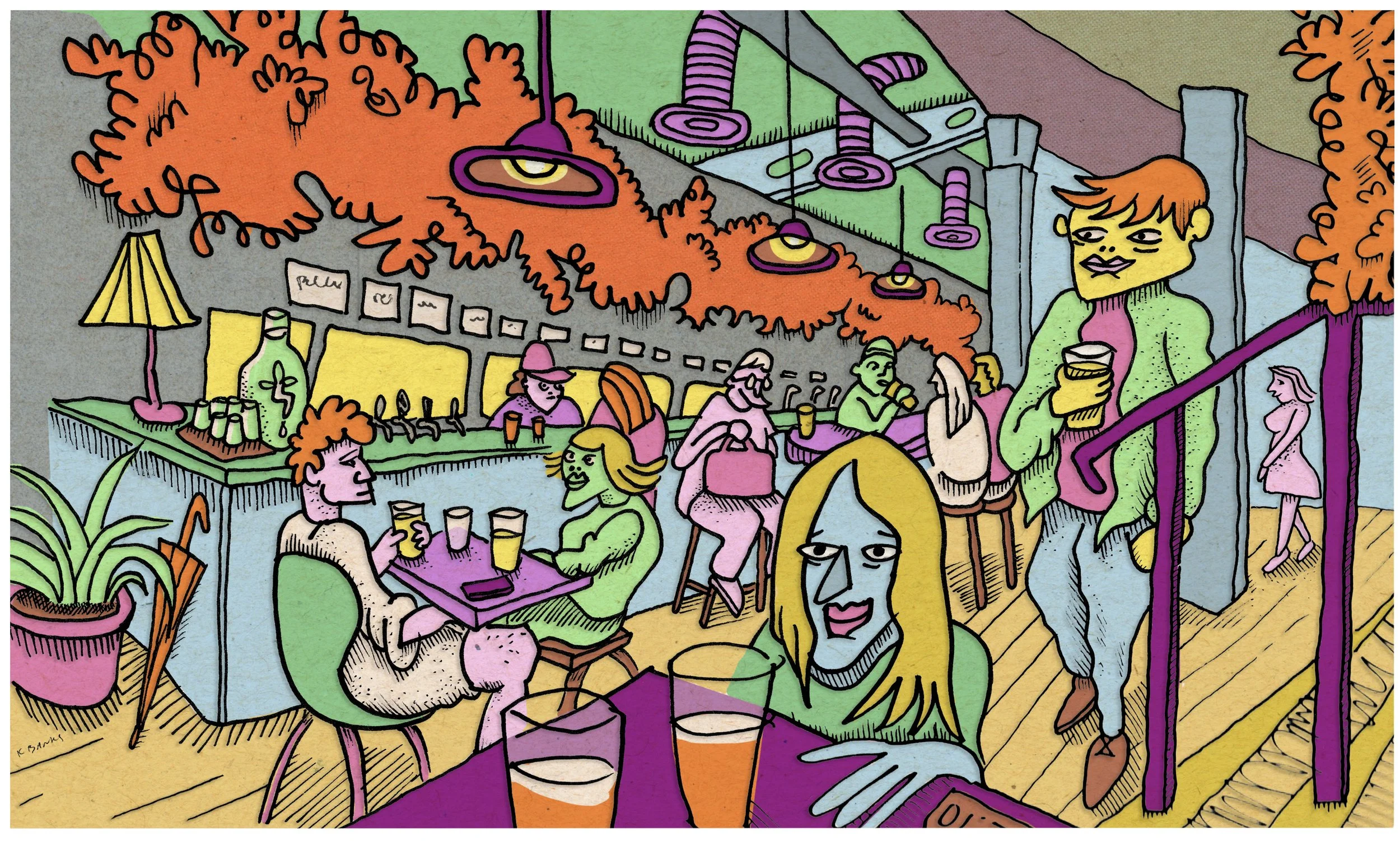
Illustrations by Kieran Banks
To call it a tight fit would be an understatement. Loved as it was, it lacked a few key components required to really shine. Natural light, for starters, plus room for significantly more customers, and a temperature-controlled cellar that would allow it to keep beer to the highest standards and dispense it on draught.
Scott, Jeremy, and their small team also spent plenty of time in that basement, often drinking long into the night. The conversations that ensued from such evenings served as motivation enough. Soon, the search for a second, larger site began.
“I think it was Simon, actually, who said that bars make better GP [gross profit] than shops,” Scott says, before letting out a laugh. “We loved the tasting room, but we just thought we could do it better somewhere else. We were selfish—we wanted to drink more stuff on draught.”
Scott, Jeremy, and Simon looked at several sites, including a handful of old-fashioned pubs, “but nothing had a good enough cellar, and it was often cramped or mouldy,” Scott says. After they reached a point where it felt like nothing would work, their property agent got in touch to tell them about a new-build, ground-floor unit that had been sitting empty for eight years. It was located on Brown Street, just a couple hundred metres from Manchester’s central shopping thoroughfare of Market Street. To the three friends, its discovery felt serendipitous.
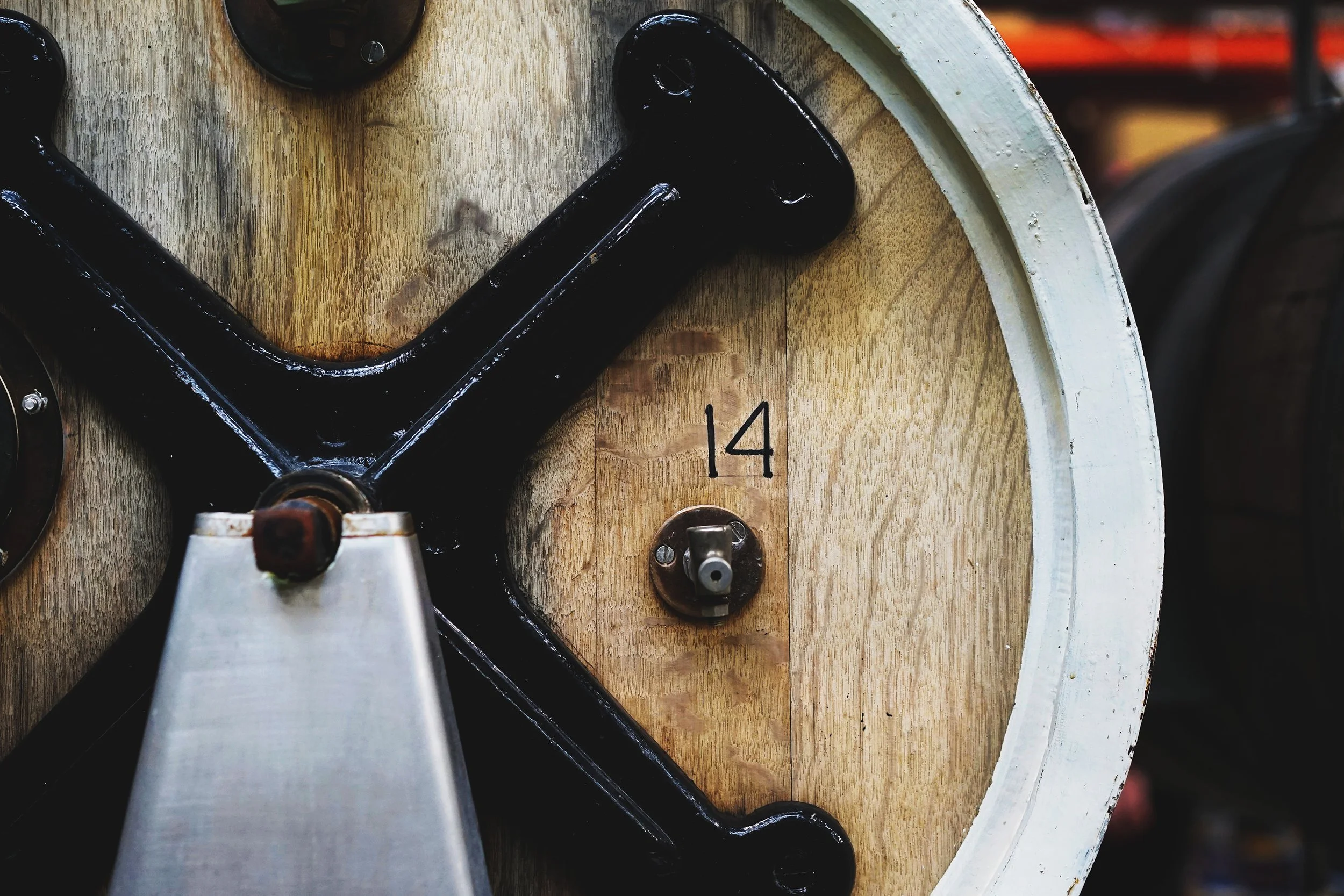
This vast, bare, concrete-and-glass space offered the team a completely blank canvas. Crucially, it also allowed them to build the bar around the cellar, which, unconventionally, became Café Beermoth’s centrepiece. It was made into a feature, visible via a large window positioned directly behind the bar.
As Scott explains, displaying the cellar so openly allows the bar to demonstrate how clean and well-maintained it is, which is vital when serving some of the best independently produced beer in the world. It also doubles as a shop window of sorts, with drinkers able to see the array of rare and interesting bottles currently in stock.
““Feeling like I’ve got someone who knows what they’re doing, really advocating for you out in the world of beer drinkers, is a huge deal.””
Café Beermoth finally opened to the general public in December 2015. I had always assumed that the “Café” part of its name was a nod to the brown beer cafés of northern Europe, and Scott admits that Café DeRat in Utrecht, the Netherlands was a big influence. In its early days, Café Beermoth even offered Brasserie de la Senne’s Taras Boulba as its house beer, initially eschewing any draught lager in favour of the iconic Brussels pale ale.
The main reason that “Café” was added to the bar’s name, however, is that it originally opened from 8 a.m., hoping to take advantage of the bleary-eyed morning crowd before transitioning into a more beer-focused hospitality space in the evening. The business model never took off, and the extended opening hours meant it initially struggled to carve out a proper identity as a beer destination.
“We probably tried to do that for a bit too long. Now we’re forced to keep selling coffee,” Scott says with a chuckle.
***
Brown Street is not the most aesthetically pleasing corner of Manchester. Here is a crowded corridor of new-build tower blocks in various shades of grey. And yet, at certain times of the year, the setting sun is channeled down the neighbouring Marsden Street, bathing the glass-fronted Café Beermoth in brilliant, golden light. It’s almost like a Bat-Signal—but instead of caped crusaders, it calls forth like-minded souls seeking the best beer the city has to offer.
There are two entrances to Café Beermoth, one at each end of its oblong room. Poised between them is the long, wood-topped bar, behind which is its centrepiece cellar. Above the bar, hung on a steel frame, are garlands of hops that have never been replaced. Once lush and verdant, they are now old, dry, and brown. Rather than detracting from the bar’s character, they somehow seem to enhance it.
Then there are the other quirky touches, like Edison bulbs hung in long-since-emptied bottles, and the rows of fairy lights suspended over the booths that face the bar. They were strung up one Christmas, but for some reason never got taken down.
These five booths are undeniably Café Beermoth’s prime real estate. There are other tables and chairs scattered around the room, but the booths are where you can squeeze eight (or perhaps more) friends in for an evening of revelry. Earlier on, they’re perfect for parking yourself for a few minutes with an Augustiner and an espresso chaser to help shake off the rigours of the day.
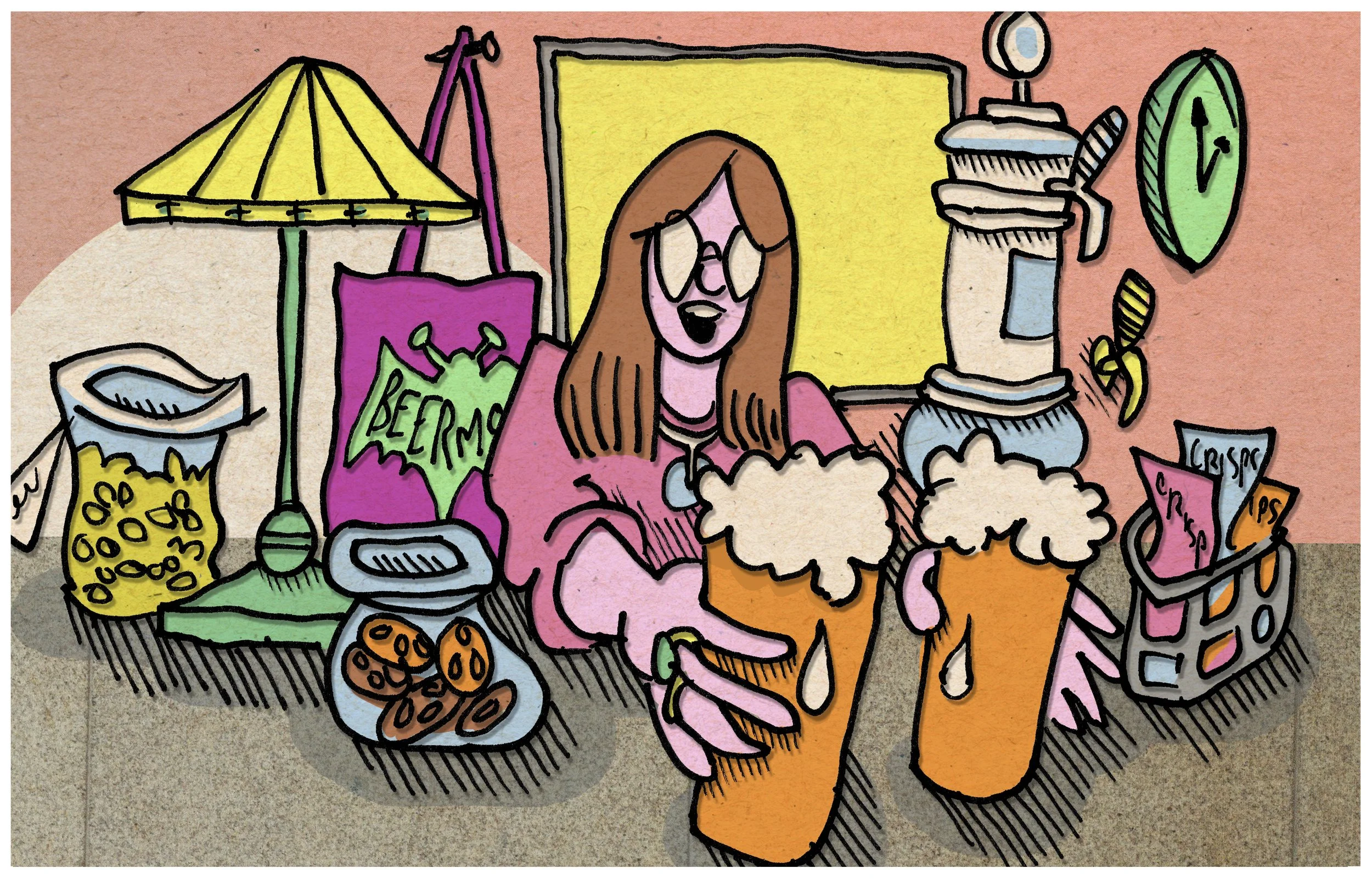
Draught Augustiner is the most recent addition to the bar’s menu. In April 2026, Café Beermoth became one of only 64 venues in the U.K., and only two in Manchester, that met the Bavarian brewery’s lofty dispense requirements. The addition brought its number of taps up to 18, 11 of which are keg and seven of which are dedicated to cask-conditioned beer. Bar the newly added Augustiner font, no branding from any brewery is on display. Instead, the beer names are listed above each tap on plain white paper, further demonstrating Beermoth’s egalitarian sensibility.
Unusually, the taps and handpulls are attached to the wall behind the bar, rather than the bar itself. This means the server has their back to you, facing the cellar, when pouring. This design choice might seem like it removes that personal touch when you’re waiting for your beer, but the opposite is true. Without the obstruction of tall and garish modern beer fonts, the service feels more personable.
“Sometimes when I’d stand outside having a cigarette, I might hear a customer say, ‘Oh, it’s a bit snobby in there,’ or something like that,” says Cal Darley, who managed Café Beermoth between 2019 and 2026, and who now works for Donzoko Brewery in Newcastle-upon-Tyne. “I think [Beermoth] is a lot more laid-back than people think. We try to make it as accessible as possible—we don’t want customers to feel condescended.”
Admittedly, with all its hard edges—the wood, the glass, the steel—Café Beermoth can perhaps feel a little cold to the uninitiated. It also doesn’t do any handholding in terms of stocking more familiar brands; Augustiner, and the occasional keg of Rothaus Pils, are perhaps the most recognisable beers on the bar. A few classics are also available in bottle and can, from Belgian staples such as Orval (various vintages are available) to American essentials like Sierra Nevada Torpedo IPA.
Imports aside, Beermoth is now primarily focused on stocking beer from small, independent, British breweries. These range from more familiar brands, like Thornbridge and Ossett, to local heroes including Track and Cloudwater. The house beer, a 4.2% cask pale ale called Stone’s Throw, is brewed exclusively for Beermoth by Runaway. The bar also regularly stocks beer from some of the smallest—not to mention the most exciting—breweries in the country, including Mills, Ideal Day, and St. Mars of the Desert.
“Cal was, without doubt, the most enthusiastic and pushy customer in terms of calling me to ask for things and making sure he got what he wanted,” St. Mars’ co-owner Martha Simpson-Holley tells me. “Feeling like I’ve got someone who knows what they’re doing, really advocating for you out in the world of beer drinkers, is a huge deal.”
***
While much about Café Beermoth has remained the same since it opened in 2015, a few things have changed over the past decade. Jeremy Stull parted ways with the bar in 2018 to pursue a brewing career that has included stints at Cloudwater and Buxton Brewery. And in January 2026, Scott and Simon decided to call time on the original Northern Quarter Beermoth location.
““We loved the tasting room, but we just thought we could do it better somewhere else. We were selfish—we wanted to drink more stuff on draught.””
“I’m not sentimental about it, even though we had 13 years of fun doing it,” Scott says. “The landlords were retiring and it felt like a chance to get everything in one place and make a few improvements. And save some money, of course.”
While there was some trepidation about bringing the contents of the shop into the bar—particularly from regulars worried their cherished space might change into something unrecognisable—there needn’t have been. The addition of the row of tall fridges proudly displaying their plentiful stock has been a boon, with off-premise sales increasing by roughly 20% as a result. The space also feels refreshed, as though it’s moved into its second era in a way that still honours its first.
Something that hasn’t changed are many of the faces behind the bar. Staff turnover at Café Beermoth is slow, and many employees who have moved on to new pastures remain regulars, and can often be found clustered at one end of the bar with those who’ve just clocked off a shift. The team is also given the opportunity to visit, and even work with, some of the breweries the bar stocks via its “Drinking Beer” series, which has included collaborations with Blackjack; London’s The Kernel; and The Riverside Brewery in Marsden, West Yorkshire. Several former employees now work full-time in the beer industry as a result.
“Right from when I started, it’s always been such a welcoming and friendly team,” says Fin Neary, who’s worked here since 2023, and presently runs the bar alongside fellow assistant manager Hollie Saunders and manager Matt Boylan. Another noteworthy team member is Joe Whinnett, who heads up the business’s marketing, comms, and online shop, and recently celebrated his 10-year Beermoth anniversary.
“Scott’s managed to create a really relaxed atmosphere, and there’s genuinely a mutual respect between everyone,” Fin tells me. “It’s really nice to be a part of.”
It’s a sentiment I agree with. I’ve been lucky enough to frequent Café Beermoth since its inception, and can now comfortably call myself a regular. Sometimes that’s all you really need from a bar: a counter with a few familiar faces on the other side; a cold, delicious beer; a happy place you can retreat to whenever it’s required.



This feeling is pulled into focus when I travel home from Maine to Manchester, and arrive at Beermoth’s door once again. Before approaching the bar and deciding what to order, I find myself pausing for a moment to take in the space and soak up some atmosphere. I consider that, before my travels, I might’ve taken the existence of this place for granted because of how close to home it is, and how familiar it has become.
I realise then that Café Beermoth isn’t just as good as Novare Res, or any of the bars I mentioned earlier. It’s better. If I could only visit one more bar in the world for the rest of my life, this would be it. And that’s because it has one thing going for it beyond every other beer destination, or indeed any other bar, I’ll ever visit: It feels like home.
***
Matthew’s latest book, Manchester’s Best Beer, Pubs and Bars Second Edition, is available now.